
Strait of Hormuz Disruptions Impact Bulk Carriers
Mar 4, 2026
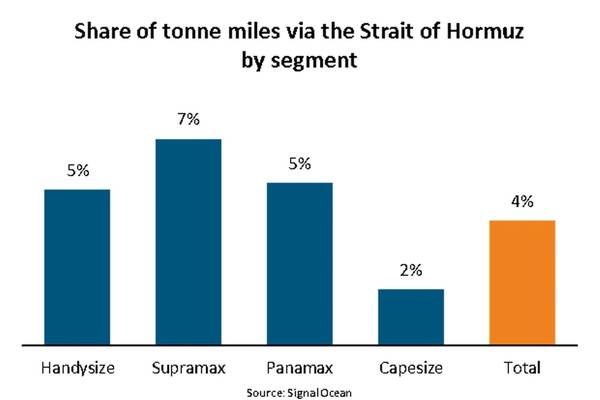
Chart courtesy BIMCO
"The attacks on Iran by the US and Israel have caused disruptions for ships transiting the Strait of Hormuz. Although this passage is less critical for the dry bulk sector than for the tanker market, the disruptions still impact around 4% of dry bulk cargo volumes and tonne mile demand,” says Filipe Gouveia, Shipping Analysis Manager at BIMCO.
Disruptions in the region have already led to a decline in traffic, and at least five ships have been attacked. The number of bulk carrier sailings through the Strait of Hormuz during the first three days of March has fallen to under a third of the levels seen in the previous week. Iranian forces have threatened to attack ships in the Strait, and the United States has so far advised ships to avoid the conflict zone. An announcement by President Donald Trump to give financial guarantees to shipowners and provide naval escorts to merchant ships, when possible, have yet to materialise and do not currently impact the situation.
“The situation in the Strait of Hormuz is rapidly changing but for now, the impact of disruptions on dry bulk freight rates appears to be limited, since ship transits have continued in reduced capacity. Sub-capesize segments are most exposed to the disruptions since 7% of supramax demand and 5% of panamax and handysize demand come from voyages transiting the strait,” says Gouveia.
Grains, iron ore and steel are the largest dry bulk commodities transported via the Strait of Hormuz to ports in the Persian Gulf, accounting for 59% of inbound volumes and 70% of inbound tonne miles. Brazil and Argentina supply a significant share of the region’s iron ore and grain imports while China is a major steel exporter.
Limestone, sulphur and urea dominate dry bulk shipments from the Persian Gulf to global markets, representing 69% of outbound volumes and 63% of outbound tonne miles. Also, 52% of global limestone shipments sail from the UAE via the Strait of Hormuz, mainly to India and Bangladesh for use in cement and steel production. Similarly, the Persian Gulf is the source of 45% of global sulphur shipments and 27% of global urea shipments delivered across the world.
“If disruptions in the area remain for an extended period, and especially if ships stop transiting the strait altogether, the dry bulk market could weaken, particularly in segments other than capesize. Import demand from countries in the Persian Gulf would decrease since overland alternatives would likely be insufficient to meet current needs. At the same time, replacing key exports from the region could prove difficult in the medium term given the limited number of alternative suppliers for commodities such as limestone,” says Gouveia.
Bulk Carriers
Cargo
Iran