
Spiridon II Hearing Adjourned
Jun 15, 2026
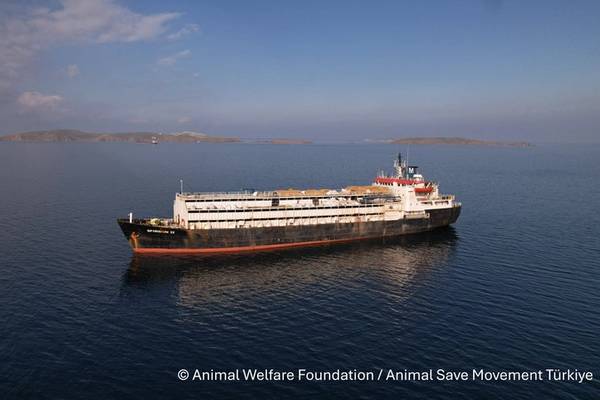
Source: Animal Welfare Foundation
No settlement was reached on Friday at the Krems Regional Court in Austria regarding the civil proceedings concerning the animal transport of the Spiridon II livestock carrier. The hearing was adjourned.
A new hearing, expected to last all day, has been scheduled for mid-November.
Several witnesses from Turkey are also expected to be heard at that time.
Turkish cattle importers are suing cattle dealer Christian Klinger and his company, Agro Breeding GmbH, based in Jagenbach, Austria. The plaintiffs are demanding the repayment of a down payment of $2.1 million, equivalent to approximately 1.8 million euros. They accuse Klinger of deceiving them and causing them financial harm in connection with the failed transport of nearly 3,000 cattle from Uruguay to Turkey in autumn of last year.
During the hearing, the Judge focused primarily on the question of who was responsible for the condition of the animals upon their arrival in Turkey: Did the problems already exist when the animals were loaded in Uruguay, or did they arise during the voyage? The plaintiffs believe the responsibility clearly lies with Klinger.
Klinger rejected all of the plaintiffs’ allegations in court. His defense attorney argued that the risk had passed to the buyers upon shipment.
Furthermore, the buyers had accepted the delayed shipment. According to his account, all ear tags were present and the transport proceeded without issue. It was only the unexpectedly long wait off the coast of Turkey that led to the subsequent problems, as the ship was not designed for such a prolonged delay.
However, the fact that it had been proven that dozens of deaths and 140 births had already occurred on board during the voyage initially played no role in court.
The plaintiffs countered that the ship was generally unsuitable for transport. They also claimed that a veterinarian hired by the importers had been denied access to the ship—a claim Klinger denied.
The case gained international attention due to the weeks-long blockade of the livestock carrier off the Turkish coast. The cattle had been loaded in Uruguay in the fall of 2025 and were to be imported into Turkey. In Turkey, the authorities ultimately refused the import because, according to the officials, hundreds of animals were not on the official import list or could not be clearly identified. Hundreds of animals died, and heavily pregnant animals gave birth to calves under precarious conditions.
The Animal Welfare Foundation and The Marker, which had brought the case of the Spiridon II to public attention, see this case as highlighting a major loophole in the international live animal trade: While importers can claim economic damages in court, the animals’ suffering is legally ignored: The animals were loaded in Uruguay, the transport was organized from Austria, and the destination was Turkey. The ship sailed under the flag of Togo; it was operated by a company based in Lebanon, while the formal owner company is registered in Honduras.
“Today in court, the main issue was when the financial risk transfers from the seller to the buyer. Even at the next hearing, the fact that thousands of animals were stranded on a ship for weeks will not play a role. The Spiridon II case shows that potential animal welfare violations during ship transport cannot be prosecuted,” says Ann-Kathrin Freude of The Marker.
“Currently, animals are not protected during transport by ship. Time and again, there are cases of severe animal suffering during these cruel transports—and those responsible pass the blame onto one another. That is precisely why we finally need binding animal welfare standards that all parties involved must adhere to. Especially in this shady business,” says Maria Boada Saña, project manager for animal transport by ship at the Animal Welfare Foundation.
Each year, member states export around three million animals by ship to third countries.
Legal
Regulation
Livestock Carriers
Law