
Global Grain Shipments Fall as Black Sea Attacks Escalate
Aug 20, 2026
Source: BIMCO
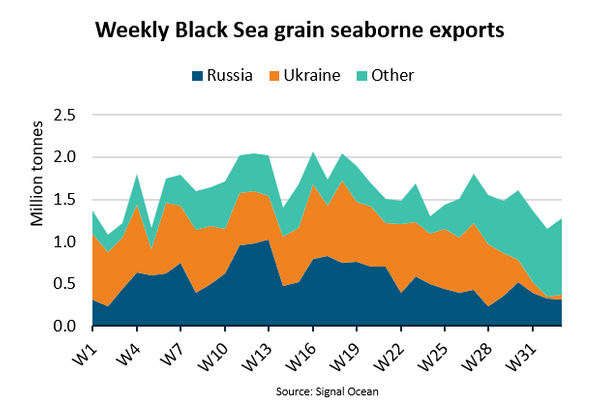
Over the last five weeks (week 29-33) global grain shipments have fallen 8% y/y, fuelled by a 26% y/y drop in grain exports from the Black Sea as Russian and Ukrainian attacks on ships and port infrastructure have intensified.
“A recent proposal by Ukraine to halt attacks on shipping in the Black Sea has been rejected by Russia, reducing hopes for a near-term recovery in exports. In addition, weaker maize shipments from Brazil due to delayed harvest have weighed on global grain volumes,” says Filipe Gouveia, Shipping Analysis Manager at BIMCO.
Attacks on ships in the Black Sea escalated on 6 July 2026 when Ukraine launched Operation MoLoChKa. The attacks initially targeted Russian-linked ships in the Sea of Azov but expanded into the Black Sea, where both ships and port infrastructure have been targeted. During the following weeks, Russia intensified attacks on Ukrainian ports and merchant ships, causing many shipowners to suspend calls at Ukrainian ports.
“While Black Sea ports account for only 3% of global dry bulk seaborne exports, the region plays a larger role in grain trade and account for roughly 14% of global seaborne grain volumes. Russia and Ukraine are among the world's largest exporters of wheat and maize, supplying countries in Africa, the Middle East, Europe and Asia. Continued disruptions could therefore have a significant impact on food prices and supply,” says Gouveia.
As a result of the disruptions in the Black Sea, Russia and Ukraine are expected to seek alternative export routes for their grain cargoes. Russia has reportedly started redirecting cargoes towards overland routes and to ports in the Caspian Sea, Baltic Sea and the Far East. However, these routes may face capacity constraints, particularly on railway links to the Far East where coal exports have already encountered bottlenecks.
Ukraine has also sought alternative export corridors, looking to redirect cargoes to its Danube ports as well as Romanian ports. However, these routes face significant capacity constraints, making them unable to fully replace the volumes normally shipped through Ukraine’s Black Sea ports.
“Ukraine's export restrictions could create significant storage bottlenecks and increase the risk of spoilage. Ukraine's Minister of Agrarian Policy and Food recently estimated that the country could face a storage deficit of 11m tonnes by November, equivalent to 13% of this year's expected grain and oilseed harvest. This risk is growing as wheat, barley and rapeseed harvesting is still ongoing, while maize, sunflower seed and soya bean harvesting is expected to begin in the coming weeks,” says Gouveia.
Government Update
Cargo
Black Sea
Grain Carriers
global trade