
U.S. Container Imports Hit Record High as China Trade Surges, Port Delays Mount
Nov 11, 2026
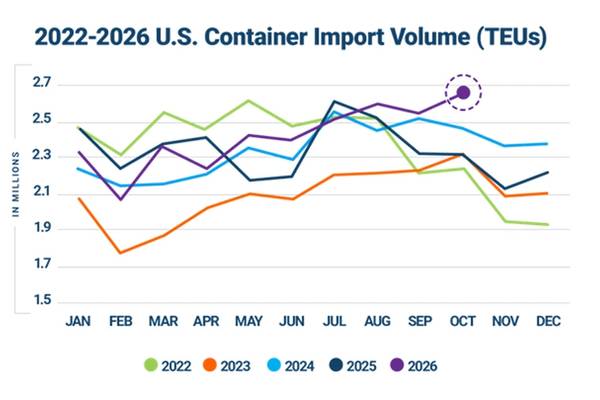
Source: Descartes Datamyne™
October 2026 container imports reached an all-time high of 2.67 million TEUs, according to Descartes, as China-origin cargo rebounded, East and Gulf Coast ports gained ground, and global shipping faced continued uncertainty over trade policy, maritime security and critical shipping routes.
U.S. container imports surged to an all-time monthly record in October 2026, reaching 2,674,808 twenty-foot equivalent units (TEUs), an increase of 5% from September and 16% compared with October 2025, according to the November Global Shipping Report from Descartes Systems Group.
The October total surpassed the previous record of 2,622,465 TEUs, established in May 2022, by more than 52,000 TEUs. Through the first 10 months of 2026, U.S. container imports were 2.3% ahead of the corresponding period in 2025, marking a significant turnaround after volumes trailed last year's pace through much of 2026.
The results reflect sustained cargo demand, a substantial recovery in imports from China and changing cargo flows through major U.S. gateways. However, the record volumes also coincide with growing port delays, evolving trade policies and persistent geopolitical risks affecting international shipping.
China Drives Import Growth
China was a major contributor to October's record performance, with imports reaching 987,805 TEUs, up 6.9% from September and 22.9% year-over-year. It was the fourth consecutive monthly increase in China-origin cargo and the highest monthly volume since January 2025.
China accounted for 36.9% of all U.S. container imports during October, up from 36.3% in September. Its 63,351-TEU monthly increase represented approximately half of the overall growth in U.S. imports.
The largest commodity categories included plastics, at 144,530 TEUs; furniture and bedding, at 137,551 TEUs; and toys, games and sporting goods, at 102,672 TEUs.
The recovery extended beyond China. Imports from the 10 largest countries of origin increased 5.8% month-over-month and 18.5% year-over-year. South Korea and Germany each recorded monthly growth of 22.8%, while all 10 leading countries posted year-over-year gains.
These figures suggest that October's strength was broadly distributed across major U.S. trading partners, even as China remained the dominant source of incremental cargo growth.
 Source: Descartes Datamyne™
East and Gulf Coast Ports Gain Ground
Cargo growth was uneven across U.S. ports, with East and Gulf Coast gateways outperforming their West Coast counterparts.
Houston recorded the largest monthly increase among the 10 leading ports, gaining 42,665 TEUs, or 26.7%. Savannah followed with a 12.6% increase, while Norfolk rose 17.7% and Charleston climbed 18.6%.
Combined Gulf Coast imports reached 266,905 TEUs, a 24% monthly increase and the highest level since Descartes began tracking the regional statistic in August 2023.
Houston accounted for approximately 83% of the Gulf Coast's monthly increase, although Descartes cautioned that part of the rebound reflected recovery from September's weaker volumes.
Meanwhile, Los Angeles imports declined 1.4%, Long Beach fell 2% and Oakland dropped 10.9%.
The five leading East and Gulf Coast gateways increased their combined market share to 39.9%, compared with 36.7% in September. The five leading West Coast gateways saw their share decline from 47% to 44.9%.
Port Delays Continue Climbing
Despite strong throughput, port performance indicators suggest mounting pressure on cargo movements.
Average transit delays across the 10 tracked gateways increased to 6.3 days in October, compared with 6.0 days in September and 4.2 days in June. That represents an approximately 50% increase over four months.
Seven of the 10 ports experienced increased delays during October, with New York/New Jersey recording 8.1 days, Seattle 7.6 days and Savannah 6.9 days.
Descartes warned that sustained import volumes exceeding 2.5 million TEUs monthly since July may be contributing to pressure on inland logistics networks.
 Source: Descartes Datamyne™
Trade Policy and Maritime Security Complicate Outlook
Beyond port operations, shipping companies face several significant regulatory and geopolitical developments.
The U.S. Trade Representative extended the suspension of specified Section 301 maritime fees and related duties targeting China's maritime, logistics and shipbuilding sectors through January 9, 2027, providing temporary relief while leaving longer-term cost exposure unresolved.
The Panama Canal Authority increased daily Neopanamax transit slots from nine to 10 beginning October 15, bringing total daily availability across both lock systems to 33.
Meanwhile, Maersk announced plans to return its India–Europe ME1 Gemini service to the Suez Canal route, although security conditions remain a determining factor.
Middle East maritime security continues to present serious concerns. According to the report, the International Maritime Organization recorded 129 confirmed shipping incidents in the Strait of Hormuz and wider Middle East through November 5.
Labor uncertainty also persists at Los Angeles and Long Beach, where negotiations involving port watchmen continue under a contract extension through November 20.
For shipowners, carriers and cargo interests, October's record imports demonstrate the strength of U.S. container demand, but also underscore an increasingly complicated operating environment.
Descartes recommends that importers closely monitor port performance, trade-policy developments, canal capacity and maritime security while maintaining flexibility in sourcing, vessel routing and inventory planning.
With cargo volumes at historic highs and operational risks accumulating, the industry's challenge is not simply moving more containers, but maintaining reliable and predictable supply chains amid shifting global conditions.
Ports
Cargo
Containershipping